
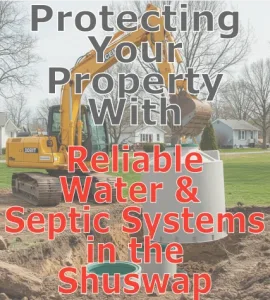
 The Shuswap region is one of the most beautiful landscapes in British Columbia. From the towering peaks surrounding Sicamous to the rolling hills of Blind Bay, the geography is as varied as it is stunning. For those who choose to build a home or a getaway in this area, the rugged terrain offers a unique set of challenges, particularly when it comes to essential utilities. Unlike urban centers where a simple turn of a tap connects a resident to a massive municipal grid, many properties in this region rely on independent infrastructure. This independence requires a deep understanding of Blind Bay Water Systems and the complex mechanics of private septic installations.
Building a reliable foundation for these utilities is not a task that property owners should take lightly. It is the hidden work – the digging, the leveling, and the precise layering of materials – that determines whether a home remains a sanctuary or becomes a source of expensive repairs. At Amigo Trucking & Excavating, we have spent over five decades mastering the art of earthmoving and material delivery. With more than fifty years of experience in the local area, we understand that protecting your property starts long before the first pipe is laid. It begins with professional excavation and the delivery of high-quality bedding materials.
The Critical Role of Precision Excavation
Excavation is often viewed as the simple act of moving dirt from one place to another. However, when it comes to water lines and septic systems, it is a highly technical process that requires extreme precision. If a trench for a water line is not deep enough, the line may freeze during a harsh Shuswap winter. If a septic pit is not dug to the exact specifications required by regional health regulations, the entire system may fail to drain correctly.
Site Preparation and Assessment
Every property in the Shuswap is different. Some lots in Sicamous may be dominated by heavy clay, while a property in Blind Bay might be sitting on top of solid rock. Before any machinery touches the ground, an experienced operator must assess the soil composition and the slope of the land. At Amigo Trucking & Excavating, we use our five decades of knowledge to anticipate how the ground will behave. Proper site preparation ensures that the excavation does not disturb the structural integrity of the surrounding land or existing buildings.
Septic Tank and Field Installation
A septic system is a gravity-fed or pump-assisted ecosystem. The placement of the septic tank requires a hole that is perfectly level and deep enough to allow for the proper “fall” or slope from the house. If the excavation is off by even a few inches, it can lead to backups or stagnant waste.
Furthermore, the drainage field – or leach field – requires even more care. The trenches must be excavated to a specific width and depth to allow for the distribution of effluent. Our team understands that the “perk” (percolation) rate of the soil dictates how these trenches are shaped. When you work with a company that has been in business for over fifty years, you are not just paying for a hole in the ground; you are paying for the assurance that the hole is in the exactly correct location and at the exactly correct depth.
The Importance of Bedding Materials
Once the excavation is complete, the focus shifts to what goes back into the ground. You cannot simply refill a trench with the same dirt that was removed. Native soil often contains large rocks, roots, or heavy clay that can compress and damage pipes or clog a drainage system. This is where the delivery of specialized materials becomes essential.
Why Washed Rock is Non-Negotiable
For septic drainage fields, washed rock is a critical component. Standard gravel contains “fines” or small dust particles. Over time, these particles wash down to the bottom of the trench and create a waterproof seal, effectively “blinding” the drain field and causing the system to fail. Washed rock has been cleaned of these particles, allowing water to flow freely through the gaps between the stones.
Sand and Fine Aggregates for Water Lines
Water lines require a different approach. Because water lines are often made of PEX or high-density polyethylene, they are susceptible to punctures if they are pressed against sharp rocks in the soil. We provide delivery of specialized bedding sand that surrounds the pipe. This sand acts as a protective sleeve, distributing the weight of the soil above and preventing the pipe from shifting or breaking.
The Logistics of Delivery
In rural areas like the Shuswap, getting these materials to the job site can be a challenge. Steep driveways, narrow access roads, and tight corners require a trucking company with a versatile fleet and skilled drivers. Whether you are installing a new system or upgrading an old one, the timely delivery of these materials is what keeps a project on schedule. Our history in the region means we know the backroads and the weight limits of local bridges, ensuring that your materials arrive when and where they are needed.
Navigating Local Regulations and Terrain
The Shuswap region is governed by specific environmental and building regulations designed to protect the clarity of our lakes and the health of our watersheds. Installing a septic system or a well is not just a construction project; it is a matter of environmental stewardship.
Interior Health Standards
In British Columbia, septic systems must meet the standards set by the Sewerage System Regulation. This involves working with Registered Onsite Wastewater Practitioners (ROWPs) or engineers. Amigo Trucking & Excavating has spent decades working alongside these professionals. We understand how to translate a technical blueprint into a physical reality that will pass inspection. We know that a mistake in the excavation phase can lead to a failed inspection, which results in costly delays and additional labor.
Protecting the Water Table
Water systems in areas like Blind Bay are precious. Whether you are tapping into a community system or a private well, the excavation for those lines must be handled with care to prevent cross-contamination. Deep trenching is required to stay below the frost line – typically about four to five feet in this region – to ensure year-round reliability. We take great care to ensure that our excavation practices do not negatively impact the local water table or the neighboring properties.
Why Five Decades of Experience Matters
In the construction industry, there is no substitute for time on the ground. A company that has operated for over fifty years has seen every possible scenario. We have worked through record-breaking winters, unusually wet springs, and the scorching heat of Shuswap summers.
Understanding Soil Behavior
Soil is a living, shifting element. It expands when it freezes and settles when it is wet. An inexperienced operator might not account for the settling that occurs after a septic tank is buried. This can lead to the tank tilting or the inlet pipes shearing off. Our team at Amigo Trucking & Excavating has the “dirt sense” that only comes from five decades of experience. We know how much to over-excavate and how much to compact the bedding to ensure that your system remains stable for decades to come.
Equipment for Every Task
Over the years, we have built a fleet that can handle the unique demands of the Shuswap. From large-scale excavations for commercial properties to small, precise jobs on residential lots in Sicamous, we have the right tools. Our experience allows us to choose the most efficient machinery for the job, which saves the property owner time and money.
Long-Term Protection for Your Investment
Your home is likely your most significant investment. The water and septic systems are the “circulatory system” of that investment. When they work well, you do not even think about them. When they fail, they are all you can think about.
By prioritizing professional excavation and the use of high-quality bedding materials, you are buying peace of mind. You are ensuring that your pipes will not crack under the weight of the earth, that your septic field will not clog after five years, and that your water will continue to flow even in the depths of January.
At Amigo Trucking & Excavating, we take pride in being a foundational part of the Shuswap community. We have helped build the infrastructure that allows this region to thrive. Our commitment to precision, our deep local knowledge, and our five-decade legacy make us the ideal partner for your next project. We do not just move earth; we build the systems that protect your property and the environment we all share.
Frequently Asked Questions
Here are five frequently asked questions related to the installation and maintenance of water and septic systems in the Shuswap region. These answers highlight the importance of professional excavation and material delivery for protecting your property.
Standard gravel often contains “fines,” which are small particles of dust and silt. If you use unwashed gravel in a drainage field, these fine particles will eventually wash to the bottom of the trench and create a sludge-like barrier. This barrier prevents the effluent from soaking into the ground, which leads to system failure and costly repairs. Amigo Trucking & Excavating delivers specifically sourced washed rock that is free of these particles, ensuring that your system remains porous and functional for many years.
In the Shuswap region, including areas served by Blind Bay Water Systems, the frost line is a significant concern during the winter months. It is standard practice to bury water lines at a depth of at least four to five feet. This depth ensures that the lines remain below the frost level even during extended periods of sub-zero temperatures. Precision excavation is required to maintain this consistent depth across the entire property, especially when navigating the rocky or uneven terrain found in Sicamous and the surrounding hills.
It is generally not recommended to use native soil for the immediate layer surrounding your pipes, known as the bedding. Native soil in this region often contains sharp rocks, heavy clay, or organic debris that can shift over time. Sharp stones can puncture or crimp plastic water lines under the weight of the earth above. We recommend the delivery of specialized bedding sand or fine aggregates. These materials provide a stable, protective cushion that prevents damage and allows for minor ground movement without causing a pipe to break.
Septic systems in British Columbia must comply with the Sewerage System Regulation administered by Interior Health. This involves a multi-step process that includes a site assessment, a system design by a qualified professional, and a final inspection. Because Amigo Trucking & Excavating has over five decades of experience, we are familiar with these requirements. We work closely with designers and inspectors to ensure that the excavation meets every technical specification, which helps you avoid the headache of a failed inspection or a permit denial.
The Shuswap has unique geological characteristics, ranging from solid rock to shifting silt. A contractor without local experience may provide a lower initial estimate but fail to account for the specialized machinery needed to break through rock or the extra time required to stabilize a site. With over 50 years of local history, we understand the “hidden” challenges of the local earth. Hiring an experienced team ensures that the job is done correctly the first time, preventing the massive expenses associated with a system that settles, leaks, or fails prematurely.