
Key Takeaway:
Population growth in the Shuswap region requires significant commercial and multi-family residential infrastructure expansion. Developing these assets demands strict adherence to local development permit processes in Salmon Arm, specialized flood plain and foundation engineering in Sicamous, adaptive geo-structural techniques in Blind Bay, and systematic water delivery upgrades through the Sorrento water systems to ensure regional resilience.
The Shuswap Transit Corridor and Regional Development
The Shuswap region is undergoing a transition from a seasonal recreational area to a year-round economic corridor. Population migration from major urban centers has increased the demand for multi-family housing and light commercial services. This shift requires developers and municipal planners to coordinate on infrastructure capacity, geotechnical realities, and local regulatory frameworks.
Construction Salmon Arm: Navigating Local Development Permits
A Development Permit (DP) is a regulatory tool used by local governments to establish specific conditions for residential, commercial, or industrial land use. It is not a building permit. A development permit must be secured prior to building permit application, subdivision approval, or any physical site alteration.
The Columbia Shuswap Regional District (CSRD) and the City of Salmon Arm designate specific Development Permit Areas (DPAs) within their Official Community Plans (OCPs).
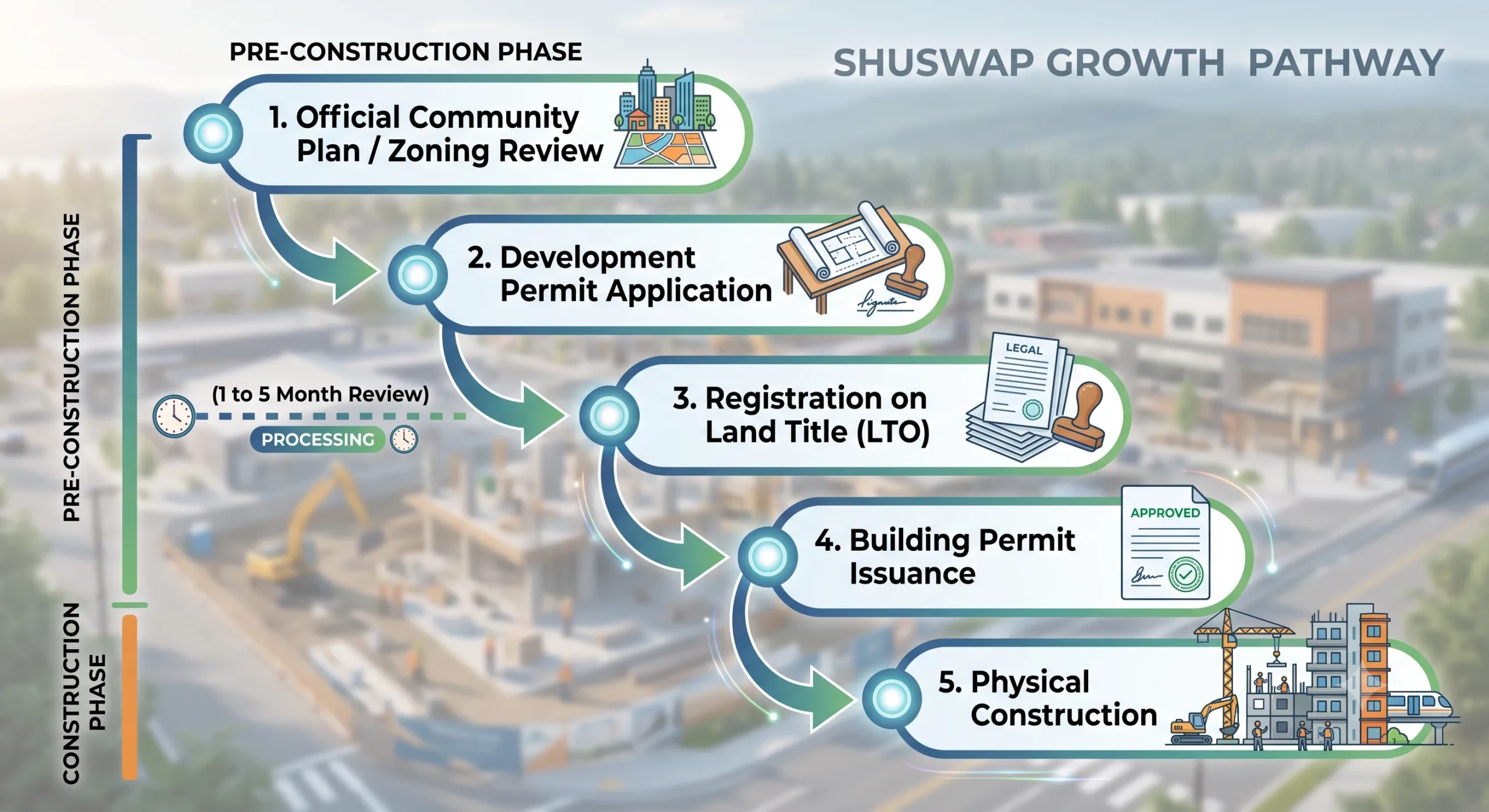
The Commercial and Multi-Family Permitting Sequence
The processing timeline for a Development Permit generally ranges from one to three months for administrative approval, and three to five months if board approval is required. Developers must execute the following sequence:
- Pre-Application Review: Developers must consult with the Development Services department to verify zoning compliance, Official Community Plan alignment, and specific Development Permit Area designations.
- Qualified Professional Procurement: If the site falls within an environmentally sensitive, steep slope, or riparian development permit area, the applicant must retain a registered professional engineer or biologist. The professional must certify that the land can be developed safely.
- Application Submission: A comprehensive application package must be submitted. This package requires the land title, detailed site plans, architectural elevations, engineered storm water management plans, and landscaping schedules.
- Agency Referral and Technical Review: Development Services staff route the application to external agencies – such as the Ministry of Transportation and Infrastructure or provincial environmental departments – for technical input.
- Permit Issuance and Registration: Once approved, the permit is registered at the Land Title Office (LTO). This registration binds all current and future owners to the development conditions.
Construction Sicamous: Flood Plain and Foundation Engineering
Construction in Sicamous requires specialized engineering due to the proximity of the Shuswap Lake and Mara Lake basins. High water tables and low-lying geography require strict compliance with the Floodplain Management Bylaw.
Flood Construction Levels and Setbacks
All new commercial and multi-family structures must design for the Flood Construction Level (FCL). The FCL is the minimum elevation established to prevent water damage to habitable spaces or commercial inventory.
- Elevation Requirements: The underside of any wooden floor system, or the top of a concrete slab used for habitation or commercial operations, must be constructed above the established FCL.
- Horizontal Setbacks: Structures must maintain defined horizontal setbacks from the natural boundary of any watercourse or lake to mitigate erosion risk.
- Exemption Covenants: If a developer cannot meet the standard FCL due to site constraints, they must apply for a floodplain exemption. This requires a geoscientist or geotechnical engineer to conduct a formal risk assessment. Approved exemptions require a Section 219 Covenant registered on the property title to release the local government from liability.
Subsurface Stabilization and Foundation Systems
The alluvial soils near Sicamous waterways exhibit low bearing capacity and high susceptibility to liquefaction during seismic events. Standard shallow strip footings are rarely sufficient for commercial or multi-family loads. Geotechnical engineers routinely specify advanced subsurface foundation designs:
| Foundation Type | Structural Application | Engineering Justification |
|---|---|---|
| Driven Steel H-Piles | Multi-story multi-family buildings | Bypasses soft, saturated silts to transfer structural loads directly to dense glacial till deep underground. |
| Helical Screw Piles | Light commercial and medium-density infill | Minimizes soil displacement and vibration, preventing settlement damage to adjacent structures on high water table soils. |
| Structural Raft Foundations | Broad footprint commercial spaces | Distributes the building weight uniformly across a thick concrete mat, reducing differential settlement on variable soils. |
Blind Bay Construction: Adaptive Geostructural Techniques
As Blind Bay expands its multi-family and commercial inventory, development is moving away from flat valley floors and toward steeper, rocky terrain. This shift introduces challenges related to slope stability, thin soils, and rocky outcroppings.
[Steep Slope Terrain] ──> Requires Rock Anchor Tiedowns & Shotcrete Stabilizers
[Varying Soil Profiles] ──> Requires Advanced Septic (Type 2/3 Treatment Systems)
Slope Stabilization and Rock Excavation
Developing multi-family terraced complexes on Blind Bay hillsides requires specialized structural interventions:
- Rock Anchor Tiedowns: High-yield steel rods are drilled deep into competent bedrock and grouted with high-strength epoxy to resist tension and prevent retaining wall failure.
- Shotcrete and Soil Nailing: Exposed soils on cut faces are stabilized by inserting steel reinforcing bars (soil nails) and applying pneumatically projected concrete (shotcrete) to prevent localized landslides.
- Controlled Blasting Operations: Close proximity to existing residential areas requires strict vibration monitoring using seismographs to prevent damage to nearby utility lines and foundations during rock excavation.
Onsite Wastewater Integration
In areas of Blind Bay where municipal sewer connections are not available, multi-family and commercial developments must construct onsite wastewater systems.
- Type 2 and Type 3 Treatment Systems: Traditional gravity fed septic systems (Type 1) are often insufficient due to poor soil percolation or shallow bedrock. Developers must install advanced mechanical treatment plants (Type 2 or Type 3) that utilize aerobic digestion, media filtration, and ultraviolet disinfection to treat effluent before it is discharged.
- Environmental Setbacks: Advanced wastewater systems must maintain strict horizontal isolation distances from Shuswap Lake and local aquifers to prevent nutrient loading and protect regional water quality.
Sorrento Water Systems: Scaling Community Infrastructure
Upgrading the Sorrento water systems is critical to supporting increased commercial density and multi-family residential developments. The system must deliver sufficient flow rates for daily consumption while maintaining adequate volume and pressure for emergency fire suppression.
System Upgrades and Capacity Management
Recent capital project plans for the Sorrento water system address several critical areas of the delivery network:
- Pipe Replacement Projects: Upgrading undersized distribution mains to large-diameter ductile iron or high-density polyethylene (HDPE) piping to reduce friction loss and increase flow capacity.
- Intake and Treatment Upgrades: Optimizing the lake intake structures and upgrading ultraviolet (UV) disinfection systems to handle higher processing volumes without compromising water safety.
- Reservoir Maintenance: Systematic cleaning, inspection, and hatch upgrades at key regional reservoirs to maintain water quality and secure storage volumes.
Commercial Connection Standards
Any new commercial or large-scale multi-family connection to the Sorrento water system must comply with strict utility guidelines:
- Mandatory Backflow Prevention: Commercial connections larger than one inch in diameter must install a certified backflow prevention assembly to prevent cross-contamination of the municipal supply.
- High-Volume Metering: Developments are required to install commercial-grade water meters with remote-read capabilities to track usage and support conservation initiatives.
- Infrastructure Fee Models: New developments must pay dynamic infrastructure extension costs based on the physical upgrades, engineering design, and pipe resizing required to service their specific property.
Frequently Asked Questions
A Development Permit focuses on land-use regulations, environmental protection, zoning compliance, and the aesthetic character of a project. It must be approved before a Building Permit can be issued. A Building Permit focuses on compliance with the British Columbia Building Code, ensuring structural safety, proper plumbing, electrical systems, and fire protection.
Sicamous is situated between Shuswap Lake and Mara Lake, making it susceptible to rising seasonal water levels. Regulations such as Flood Construction Levels and specific setback requirements prevent structural damage to properties, minimize economic losses during high-water events, and protect municipal infrastructure from overloading.
If physical constraints prevent a development from meeting the required elevation, the developer must apply for a floodplain exemption. This process requires a qualified professional engineer to write a technical report proving the site can be developed safely. If approved by the regional district, the property owner must sign a Section 219 Covenant releasing the local government from liability.
Blind Bay features areas with thin soils, steep slopes, and nearby bedrock, which prevent standard gravity septic fields from operating safely. Type 2 and Type 3 systems use advanced mechanical filtration and purification technologies to treat wastewater before discharge, preventing contaminated runoff from reaching local aquifers or Shuswap Lake.
New commercial connections over one inch in diameter must install an approved backflow prevention device to safeguard the municipal water supply. They are also required to install remote-read water meters and pay connection fees that cover the actual cost of any necessary engineering or water distribution pipe upgrades.