
Key Takeaway: Winterizing Shuswap properties requires systematic maintenance of rural infrastructure before freezing temperatures and heavy snow loads arrive. Essential property protection involves insulating Blind Bay septic lines, purging seasonal Sorrento water systems, planting snow load resistant native flora, and constructing driveways with proper crowning and drainage. These steps mitigate frost heave, ice formation, line blockages, and costly structural site damage.
Understanding Shuswap Winter Climate Dynamics
Winter weather in the Shuswap region is characterized by severe sub-zero temperatures, deep frost penetration, and heavy, wet snow accumulation. Temperatures frequently drop below minus fifteen degrees Celsius, driving frost depths up to four feet into the soil depending on snow cover and soil moisture.
Snow cover acts as a natural insulating thermal blanket over the ground. However, cleared areas such as driveways, pathways, and compacted soil zones experience much deeper frost penetration. Freezing temperatures combined with saturated soil conditions trigger frost heave, expanding the ground and exerting immense lateral and upward pressure on underground pipes, wellheads, and road bases. Property owners must prepare infrastructure prior to the initial hard freeze to prevent catastrophic mechanical and structural failures.
Blind Bay Septic Systems: Preventative Winterization Techniques
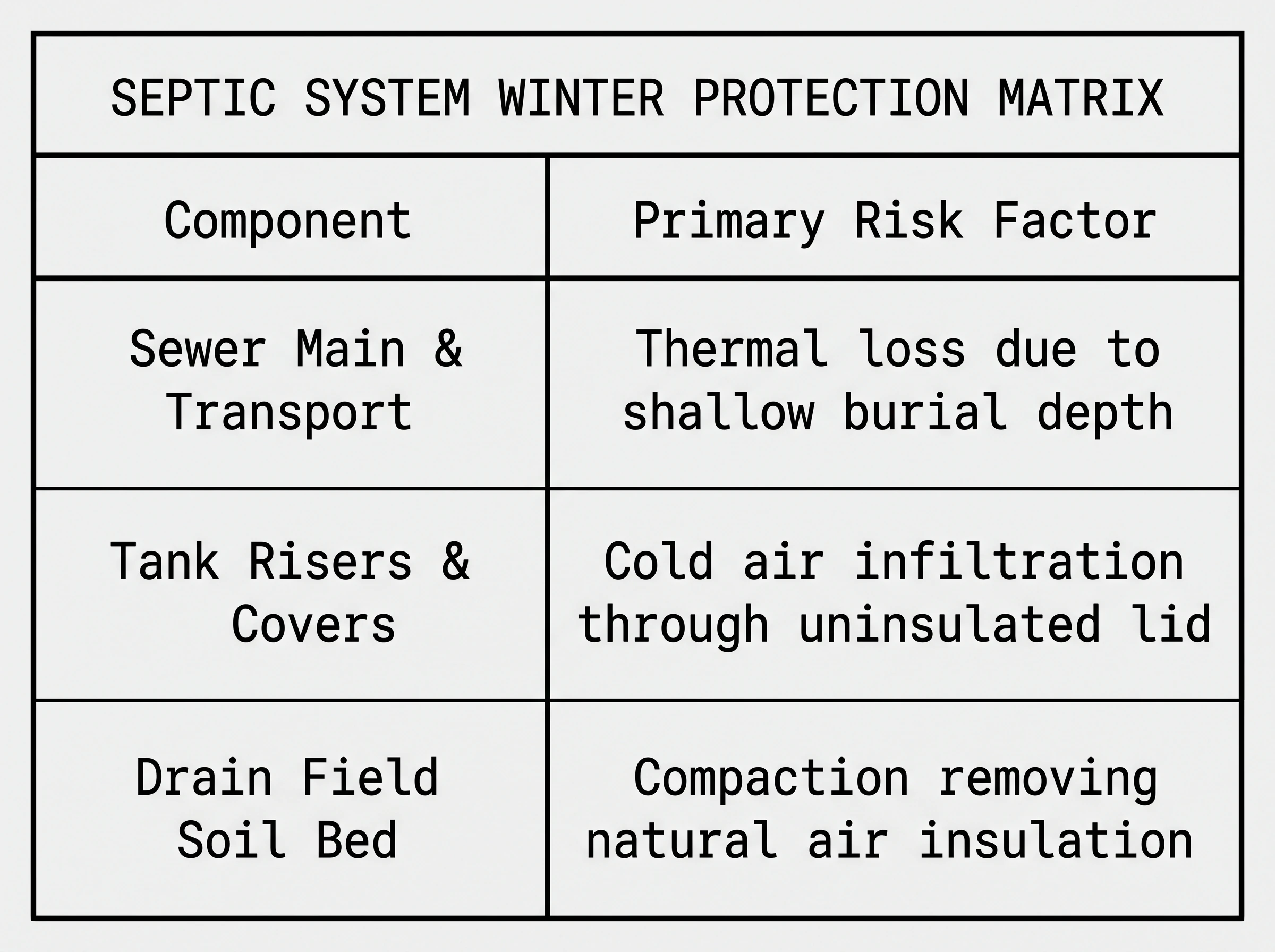
A residential septic system is an underground wastewater treatment structure designed to collect, treat, and disperse household sewage. In cold climates, unprotected septic tanks, transport pipes, and drain fields are vulnerable to deep freezing, which leads to line blockages, backup of sewage into structures, and pipe ruptures.
Insulating Septic Lines and Tank Risers
Septic lines convey effluent from the residential structure to the septic tank and subsequently to the drain field. Thermal protection is necessary when pipes are buried above the local frost line or pass beneath snow-cleared driveways.
- Install closed-cell extruded polystyrene insulation boards – rated at minimum R-10 – directly over shallow sewer pipes before backfilling.
- Cover septic tank lids and inspection risers with insulated riser covers or specialized thermal caps to prevent cold air entry into the septic tank.
- Place a six-to-eight-inch layer of uncompacted mulch, straw, or leaves over the pipe trench to provide secondary thermal protection.
- Ensure all effluent lines maintain a continuous downward slope of at least one-quarter inch per foot to prevent standing water from freezing inside the pipe.
Drain Field Soil and Vegetation Management
A drain field – or leach field – is a network of perforated pipes placed in gravel-filled trenches designed to absorb treated effluent into the soil. Compaction of the soil directly above the drain field reduces its thermal retention capabilities and destroys the soil structure required for filtration.
- Discontinue all vehicular and heavy equipment traffic over the drain field to prevent soil compaction and pipe crushing.
- Leave grass unmowed over the drain field during the late autumn to allow tall vegetation to trap falling snow, which creates a natural insulating blanket.
- Avoid removing snow from the drain field area; bare ground allows frost to penetrate much deeper into the effluent dispersal pipes.
- Inspect and pump the septic tank prior to winter if sludge levels are high, as full tanks freeze more rapidly than active, biologically warm tanks.
Sorrento Water Systems: Protecting Wells and Seasonal Piping
Water supply systems in rural areas rely heavily on groundwater wells, shallow intake lines, and surface distribution pipes. Unprotected water lines freeze rapidly when ambient temperatures remain below zero degrees Celsius, causing ice blockages and burst pipes.
| System Type | Winter Threat | Core Mitigation Strategy |
|---|---|---|
| Seasonal Water Lines | Trapped water expansion | High-volume compressed air blowout |
| Shallow Wellheads | Frost heave and cap freezing | Insulated well huts and self-regulating heat trace cable |
| Above-Ground Pumps | Internal casing fracture | Complete drainage and dry storage |
High-Volume Air Purging of Seasonal Water Lines
Blowing out seasonal water lines is the process of using compressed air to evacuate all residual moisture from water distribution pipes before winter. Residual water trapped in low points of horizontal pipes expands by roughly nine percent upon freezing, splitting PVC, PEX, and copper lines.
- Shut off the main water supply valve at the primary source or well pump.
- Open all domestic faucets, drain valves, and exterior hose bibbs to allow gravity draining of the system.
- Connect an industrial air compressor to the main blow-out port using a regulated pressure fitting.
- Set the compressor air pressure regulator to a maximum of thirty pounds per square inch for plastic piping or fifty pounds per square inch for rigid metal piping to avoid pipe damage.
- Open each distribution line systematically – working from the highest elevation valve to the lowest elevation valve – until only air escapes the discharge ports.
Protecting Shallow Wellheads and Pitless Adapters
A wellhead is the visible above-ground structure of a groundwater well that provides access to the water casing and internal pump components. Shallow wellheads and uninsulated pitless adapters are susceptible to freezing during sustained cold snaps.
- Wrap exposed well casings and wellheads with weather-resistant insulation rolls rated for exterior usage.
- Install a self-regulating heat trace cable along exposed piping sections and secure it with aluminum thermal tape.
- Construct or place an insulated, weatherproof well hut over the wellhead assembly to shield components from windchill and snow accumulation.
- Verify that the pitless adapter – the connector that routes water horizontally below the frost line – is seated securely below the localized four-foot frost depth.
Blind Bay Landscaping: Heavy Snow Load Plant Selection
Landscaping in cold climate environments involves selecting plant species and implementing structural configurations capable of handling deep snow accumulation, ice storms, and winter desiccation. Heavy, wet snow places high mechanical loads on plant branches, leading to splitting and structural failure.
Native Plant Selection Criteria
Native plant species have evolved physiological mechanisms to withstand the specific temperature extremes, snow weights, and soil conditions of the region.
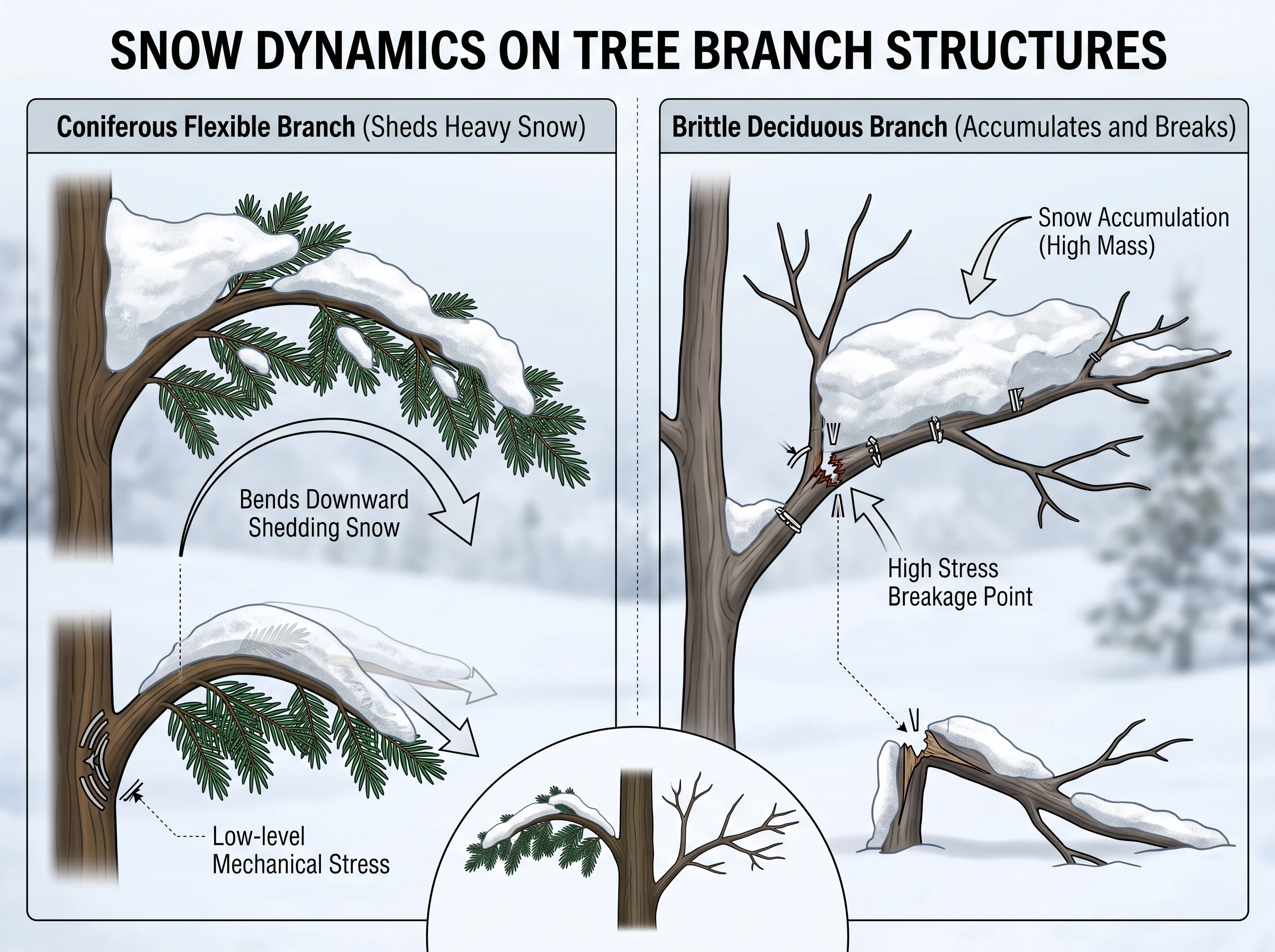
- Select Douglas Fir (Pseudotsuga menziesii) and Subalpine Fir (Abies lasiocarpa) for structural plantings, as their flexible, downward-sloping branches naturally shed heavy snow accumulation.
- Plant Red-Osier Dogwood (Cornus sericea) in exposed zones; its pliable, multi-stemmed structure bends under snow weight without snapping.
- Utilize Saskatoon Berry (Amelanchier alnifolia) and Kinnikinnick (Arctostaphylos uva-ursi) for slope stabilization and ground cover, as both species tolerate freezing ground temperatures and thick snow blankets.
- Avoid planting brittle wood deciduous trees – such as hybrid poplars or silver maples – near structures, utility lines, or high-traffic pedestrian zones.
Pre-Winter Vegetation Management Procedures
Proper physical preparation of existing flora mitigates structural breakage caused by heavy snowpacks and freezing rain.
- Wrap delicate columnar shrubs – such as junipers and cedars – with burlap or heavy-duty twine to hold branches tightly together against snow loads.
- Prune dead, damaged, or structurally weak branches from mature trees prior to the first major snowfall to prevent limb failure.
- Apply a three-to-four-inch layer of organic wood mulch around the root zones of young plants to insulate soil and retain root moisture.
- Erect wooden A-frame shelters over foundation plantings located directly beneath roof drip lines to deflect sliding snow chutes.
Blind Bay Road Building: Driveway Drainage and Crown Design
Driveway engineering in freezing environments focuses on managing surface water runoff and preventing sub-base saturation. Saturated road bases freeze, expand, and break down surface materials, resulting in deep ruts, potholes, and hazardous sheet ice.
Constructing Driveway Crowns and Slopes
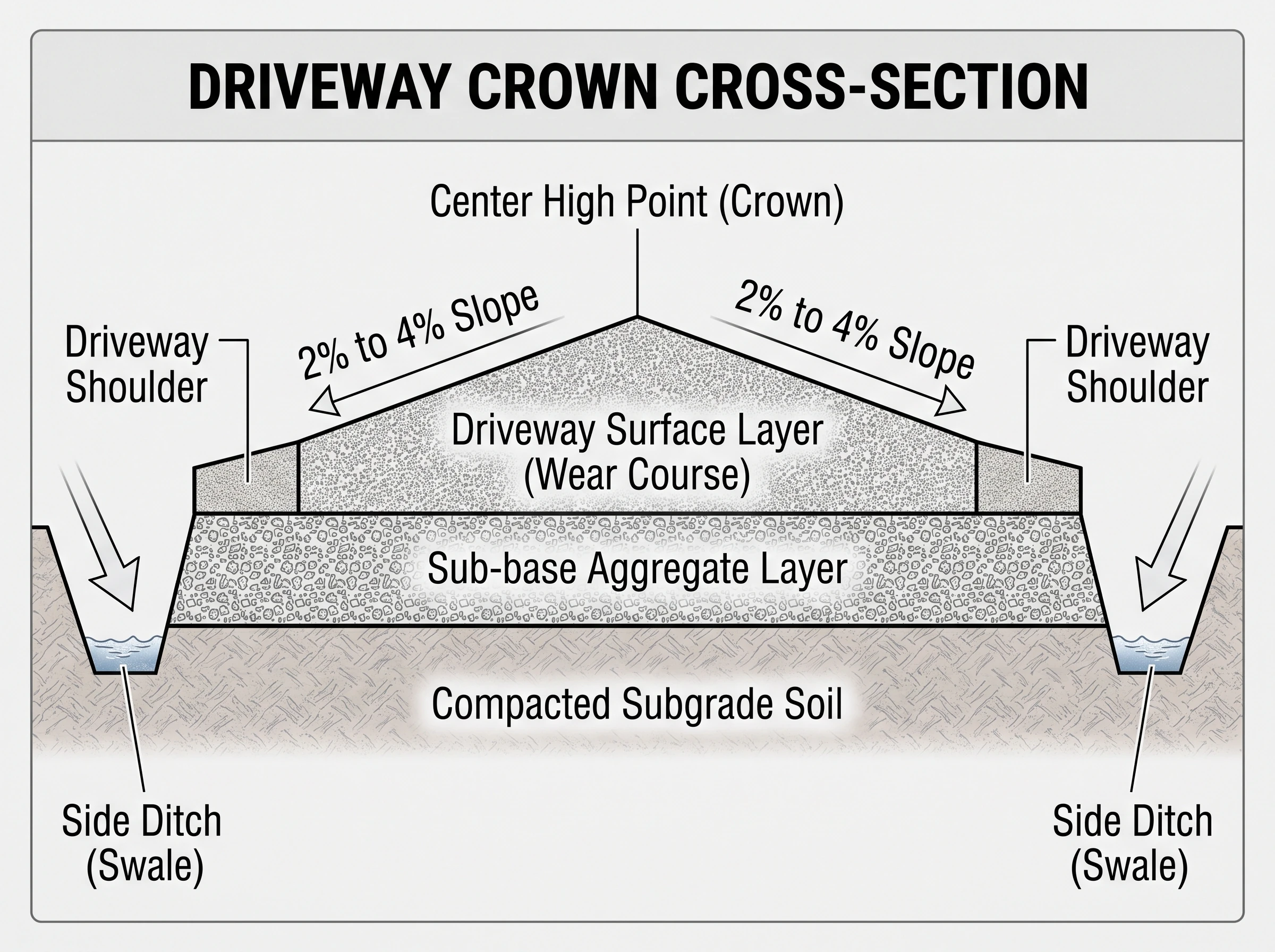
A driveway crown is the intentional elevation of the center of the road relative to its edges. This geometric profile forces surface water to shed sideways into drainage ditches rather than pooling on the travel surface.
- Establish a continuous crown slope of two to four percent from the center ridge line down to the outer shoulders.
- Maintain a smooth cross-slope profile using a motor grader or tractor blade to eliminate low spots where water accumulates.
- Grade gravel surfaces late in the autumn while moisture remains in the soil, allowing proper compaction before the ground freezes.
- Apply a top layer of crushed aggregate containing a mix of fine binders to create a dense, water-shedding surface layer.
Surface Drainage Systems and Culvert Installation
Drainage systems intercept surface runoff and subsurface water, directing it away from the road structure before it can freeze into sheet ice across the driveway.
- Excavate roadside ditches – or swales – along the upper sides of driveways to capture overland water flow.
- Install heavy-duty corrugated steel or high-density polyethylene culverts at low points and driveway intersections to pass water underneath the roadbed.
- Extend culvert inlet and outlet pipes beyond the fill slope to prevent erosion of the driveway shoulders.
- Clear debris, leaves, and rocks from culvert openings in late autumn to ensure unobstructed flow during winter mid-thaw events.
- Place rip-rap stone at culvert outlets to dissipate water velocity and prevent soil erosion.
Frequently Asked Questions
Water supply lines must be buried at a minimum depth of five feet (1.5 metres) below the finished ground surface. This depth places the pipes beneath the maximum expected local frost penetration line. In areas where soil conditions prevent four-foot burial depths, rigid extruded polystyrene insulation boards rated at R-10 or higher must be installed above the pipe along with heat trace cables.
To prevent a well casing from freezing, construct an insulated, weather-tight well house over the wellhead assembly. Install a thermostatically controlled heat trace cable along the exposed casing and piping. Ensure all gaps around the casing entry points are sealed with weather-resistant sealant to prevent cold air drafts from entering the enclosure.
Protecting a gravel driveway from frost heave requires thorough water management. Establish a center crown with a two-to-four-percent slope to shed water immediately. Dig roadside ditches to collect runoff, and install geotextile fabric beneath a crushed aggregate sub-base to prevent groundwater from migrating upward into the driveway surface layers.
Continuous use helps prevent septic system freezing because household wastewater introduces heat into the system. However, septic lines can still freeze if pipes are improperly sloped, buried too shallow, exposed to cold air drafts through uninsulated risers, or if cold water drips continuously from leaking fixtures inside the home.
Heavy, wet snow exerts extreme mechanical pressure on tree branches. Non-native species often feature branch architecture or wood densities that cannot support these heavy loads. Under the weight of dense snowpacks, branches split, bark tears, and main trunks snap, leading to structural plant failure and potential property damage.