
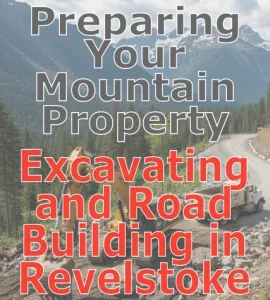
 Building a dream home or a commercial facility in the heart of the Selkirk and Monashee Mountains is a pursuit that offers unparalleled rewards. The jagged peaks, ancient forests, and the deep, crystalline waters of the Columbia River provide a backdrop that is world-class. However, before the first timber is framed or the first window is set to capture a mountain view, a massive logistical and physical undertaking must occur. The rugged terrain of the interior wetbelt requires more than just a vision; it requires heavy machinery, engineering precision, and a deep understanding of the local geology. Revelstoke Excavating is the foundational stage of any mountain project, serving as the bridge between raw, untamed wilderness and a stable, buildable site.
In a region known for its record-breaking snowfall and steep gradients, site preparation is not a task for the inexperienced. The earth here is a complex puzzle of glacial till, massive boulders, and dense timber. Moving this earth requires a strategic approach that respects the power of nature while creating a lasting footprint for human habitation. This article explores the essential heavy-duty services and expertise required to master the challenging landscapes of Revelstoke.
The Reality of Revelstoke Excavating: Moving Mountains
The first step in any construction project is clearing the way. In Revelstoke, this is rarely a simple matter of stripping topsoil. The land is often dominated by dense stands of cedar and hemlock, with root systems that have interlaced over decades. Once the timber is managed, the true challenge begins beneath the surface.
The geology of the Columbia River valley is characterized by a mix of heavy clay, silt, and “glacial erratic” boulders that can be the size of a small vehicle. Revelstoke Excavating professionals, like Amigo Trucking & Excavating, must utilize high-capacity excavators equipped with hydraulic thumbs, rippers, and occasionally hoe-rams to break through stubborn rock formations. The goal is to reach a “competent” subgrade – a layer of earth that is stable enough to support the weight of a structure without shifting.
Furthermore, the slope of the land dictates every move. Tiered excavation and the creation of structural benches are often necessary to manage the steep inclines. This process ensures that the building pad is level and that the surrounding slopes are stabilized to prevent future erosion or landslides. Without professional excavation, a property owner risks long-term structural settling or catastrophic drainage failures.
Revelstoke Dump Truck Services: The Logistics of Displacement
Excavating a mountain site creates a massive volume of material that must be managed. When you dig into a hillside to create a level pad, you are often left with hundreds of cubic yards of “spoil” – a mixture of stumps, rocks, and unusable soil. This is where dump truck services, provided by Amigo Trucking & Excavating, become the backbone of the operation.
Efficient site preparation relies on a constant flow of traffic. Tandem and tridem dump trucks are essential for hauling away debris to approved disposal sites. However, the job is not just about removal. To create a stable foundation, “structural fill” must be brought in. This usually consists of crushed rock, 3-inch minus pit run, or engineered gravel that provides superior drainage and compaction compared to the native “muck” found in many low-lying or heavily forested areas.
The logistics of these services are particularly challenging in Revelstoke due to narrow mountain roads and seasonal weight restrictions. A local expert knows exactly when the “frost pins” are in or out, ensuring that heavy loads do not damage public infrastructure or get stuck in the soft spring mud. The coordination between the excavator operator and the truck drivers is a choreographed dance that keeps a project on schedule and on budget.
Revelstoke Road Building: Engineering for the Elements
A mountain home is only as good as the road that leads to it. In the Kootenays, a driveway is not just a place to park a car; it is a critical piece of infrastructure that must perform under extreme conditions. Revelstoke Road Building requires a focus on two primary enemies: water and snow.
Managing Heavy Runoff
Revelstoke receives significant annual precipitation, much of it coming in the form of rapid snowmelt in the spring. If a road is not designed with proper “crowning” and deep ditches, the runoff will quickly turn a driveway into a creek bed, washing away expensive surfacing. Culvert installation is a science here. Professionals must calculate the expected water volume to ensure culverts are large enough to handle peak flows without washing out.
Winter Accessibility
A road must also be navigable in the winter. This means keeping grades as mellow as possible – ideally under 10 to 12 percent – so that snowplows and delivery vehicles can safely climb the slope. Sharp switchbacks must be engineered with wide radii to accommodate the “swing” of larger vehicles. Proper road building also involves choosing the right top-dressing; a well-compacted crushed rock surface provides the necessary traction that smooth asphalt or simple dirt cannot offer in icy conditions.
Revelstoke Construction: The Necessity of Local Expertise
It is a common mistake for developers to assume that construction techniques used in the Okanagan or the Lower Mainland will work in the interior mountains. The “wetbelt” environment of Revelstoke creates unique soil compositions. You may find pockets of “blue clay” that hold water like a sponge or “running sand” that shifts as soon as it is disturbed.
Hiring a local expert for construction and site prep, such as Amigo Trucking & Excavating, is a necessity for several reasons:
- Understanding Soil Mechanics: Locals know which areas of the valley are prone to high water tables and where the bedrock is likely to be found just inches below the moss.
- Weather Window Management: The construction season in the mountains is short. A local team knows how to maximize the summer months and how to “winterize” a site so that the spring thaw does not destroy the work completed in the autumn.
- Environmental Stewardship: Revelstoke is home to sensitive ecosystems and fish-bearing streams. Local contractors are familiar with the Riparian Areas Protection Regulation (RAPR) and other environmental mandates, ensuring that excavation work does not result in fines or ecological damage.
When you invest in local area expertise, you are not just paying for a machine and an operator. You are paying for the peace of mind that your foundation will remain solid when the snow piles six feet high and the spring rains begin to fall.
Frequently Asked Questions
While some work can occur in the winter, the ideal window is from late May through October. Starting too early in the spring can be difficult due to “road bans” (weight restrictions) and extremely saturated ground which makes compaction nearly impossible.
If the slope of your land is greater than a 2:1 ratio (two feet horizontal for every one foot vertical), you will likely need a retaining wall to ensure stability. Road building often incorporates large “lock-block” or natural rock walls to hold back the hillside and create a wider, safer driving surface.
Most native soil in Revelstoke contains high organic content or fine silts that retain water and expand or contract with the frost. For a house foundation, you need “clean” structural fill that allows water to drain through it and stays stable under pressure.
Yes. Depending on the location and the scale of the project, you may need a Development Permit, a Building Permit, and potentially an Environmental Assessment if you are working near water or on steep slopes. A local contractor can often help navigate these municipal requirements.
Many property owners choose to have the merchantable timber hauled to a local mill. The remaining stumps and “slash” are usually buried in a designated pit on-site (if permitted) or hauled away by Revelstoke Dump Truck Services to a green waste facility.